
Fish the Size of Submarines: Lake Iliamna’s Illie, the Monster That Shouldn’t Exist

On a calm September day in 1942, a Stinson bush plane crossed the deep, blue‑black water of Lake Iliamna on what should have been an uneventful hop to the village. The pilot, a man named Babe Alsworth, had flown this route enough times that the lake usually registered as background—just a broad, dark slab beneath his pontoons. Beside him sat fisherman Bill Hammersley, watching the scattered islands slide past below. Then Alsworth noticed something that did not fit. Near an unnamed island in the middle of the lake, pale specks broke the uniform surface, too regular and too still to be whitecaps.
At first he dismissed them as logs or light hitting submerged rocks. The day was clear, the water calm, and Lake Iliamna is large enough that stray debris is not exactly rare. But as the plane drew closer and the angle changed, those specks lengthened into shapes. They were not bobbing the way driftwood would in a light chop. They were not anchored to any visible outcrop. They were moving together, just beneath the surface, with a slowness that felt deliberate. Curious, Alsworth banked the Stinson and swung the plane around for another pass.
On the second loop, the view snapped into focus. There, under the glassy water, lay multiple elongated, aluminum‑colored bodies, thicker than any known fish in the lake and at least as long as the pontoon beneath him. He later described them as “giant fish,” with fish‑like tails and long, solid backs that reminded him, more than anything, of a row of miniature submarines cruising in formation just below his wings. They did not surge or break into spray.
They glided, huge and silent, through the dark. Whatever else you might say about Lake Iliamna’s monster, that moment carved out the shape of the modern legend: something too large and too solid, in a freshwater lake too well known, moving in a way that suggested it belonged there.
Alsworth finished the flight. Nothing surfaced to attack the plane. There were no dramatic breaches or splashes—only the unsettling knowledge, replayed for decades afterward, that he had seen several living things in that water that should not have been there at all.
A Lake Too Big To Be Empty: Where the Iliamna Lake Monster Fills in the Gaps
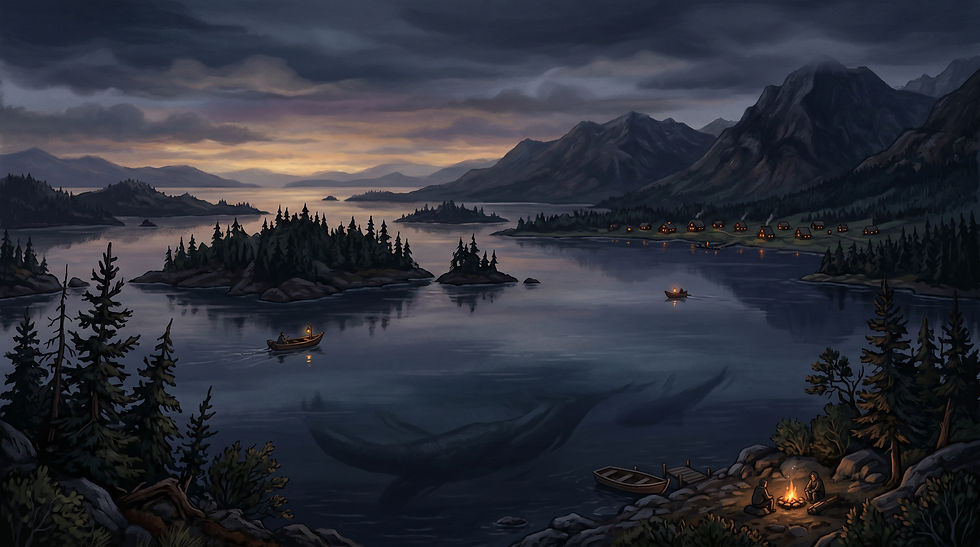
Lake Iliamna is the kind of water body that tricks the mind at scale. On a map it looks big; in person it feels excessive. Roughly seventy‑seven miles long, up to a thousand feet deep, and covering around a thousand to twelve hundred square miles depending on which measurement you use, it is the largest lake in Alaska and one of the largest in the entire United States.
From the air it reads like a piece of inland sea, with islands dotting its surface and far shores you can lose in haze.
It is not, however, a hidden tarn tucked in a forgotten valley. Villages ring its edges. Between five and eight million adult sockeye salmon return through its watershed each year, feeding one of the most productive fisheries in Bristol Bay. Subsistence fishermen, sport anglers, bush pilots, and locals in skiffs work these waters hard. On a summer day it is entirely possible to see multiple boats scattered across a single reach, each set on its own business.
That is part of what makes Illie—the Iliamna Lake Monster—such an enduring irritation for skeptics. This is not a deep, inaccessible crater lake where rumors can hide behind lack of eyes. It is a big, busy piece of water. The more people there are on and above that surface, the more odd sightings seem like they should have been chased into an explanation by now. Yet the core description stays stubbornly strange: a very large fish, anywhere from ten to thirty feet in length, with a dull or aluminum‑colored back, a blunt or squareish head, and enough mass to frighten people used to handling big salmon and trout.
If that were all, it might be tempting to file Illie alongside Nessie or Champ as another provincial mascot in the wider cryptid menagerie. But Lake Iliamna’s monster is not just a new story. It is the latest name hung on something older. Before there was Illie, there were Jigiknak and Gonakadet.
Monsters Before Monsters

Long before airplanes stitched the sky over Iliamna, people on the ground and coast were already giving shape to things in the water. Along the Southeast Alaska and British Columbia coasts, Tlingit communities told stories of Gonakadet, a powerful “fish god” depicted in pictographs as a large, water‑dwelling being with the head and tail of a wolf and the body of an orca. Gonakadet was not a cryptid in the modern sense. It was a spirit animal and a force, capable of bringing fortune or misfortune to those who encountered it, and its presence underlined the fact that deep coastal waters have rules that are not set by people.
Farther west, Aleut and Unangan people used another name for something at least adjacent: Jig‑ik‑nak. In those stories, Jigiknak are fish‑like monsters that travel in groups, attacking canoes and killing warriors. They are not shy, not solitary, and not the sort of thing a hunter goes out seeking. Instead, they are treated as an ambient hazard, one more reason to respect certain stretches of water and to understand that being on the surface does not mean you are in charge. The Aleut did not boast about hunting Jigiknak; they talked about staying away from where Jigiknak were believed to live.
When English‑language media and later cryptid culture began to take an interest in Alaska’s “lake monsters,” those older beings were pressed into a new mold. Gonakadet and Jigiknak were recast as proto‑Illies—local antecedents for what could now be presented as Alaska’s answer to Loch Ness. In the process, some of their complexity was sanded down. The spiritual roles and cultural etiquette coded into those stories lost space to more straightforward questions about biology: is there a breeding population? What do they eat? Could a prehistoric fish survive undetected here?
Even with that flattening, though, the overlap is hard to ignore. In all three frames—Gonakadet, Jigiknak, and Illie—the water is not neutral. It contains something with agency and scale, something that can overturn a boat or end a life if you are in the wrong place at the wrong time. The names change. The job description does not.
The Submarines Under the Wing

Within that older landscape of warning, the Alsworth–Hammersley sighting hits differently. 1942 was not a quiet year for the world, but Lake Iliamna’s rhythms remained local: fish, weather, and the slow, steady business of getting people and supplies between villages. On that September day, Alsworth’s plane was just another moving piece in that system, a Stinson ferrying a fisherman over familiar water.
According to accounts later given to researchers like Loren Coleman, the strange part began with those “unusual specks” near the unnamed island. What set them apart from normal drift wasn’t their presence, but their behavior. They held position and line in a way that suggested intent rather than random drift. As the Stinson moved over them, they did not scatter the way a school of salmon might. Instead they revealed their length.
Alsworth’s description has been remarkably consistent. The creatures were long—at least as long as the plane’s pontoon, somewhere in the twenty‑ to thirty‑foot range—and dull or aluminum‑colored, with elongated bodies and fish‑like tails. They lay just under the surface, their backs catching light in a way that made them look like metal more than flesh, hence the “submarine” analogy that has stuck to them ever since.
They did not behave like mammals. No heads broke the surface to breathe. No backs humped up in arcs characteristic of seals or small whales. They simply cruised, side by side, in deep, cold freshwater a very long way from the sea. It was the combination of that movement and that setting that lodged the sight in Alsworth’s mind.
Years later, when cryptid‑curious oilman Tom Slick took interest in the Iliamna monster, he hired Alsworth for aerial searches in the hope that lightning might strike twice. The pilot flew Slick over the lake in 1959, scanning for more “submarines” under the surface. They saw nothing conclusive. Still, the hunt itself—and the fact that a man as practical as Alsworth was willing to spend time on it—helped cement Illie’s modern profile as something more substantial than a campfire rumor.
A Lake Full of Stories

Alsworth and Hammersley are far from the only people to insist they have seen something out of scale in Iliamna. The lake’s modern history is pocked with reports from villagers, hunters, pilots, and visiting anglers who say they have watched something enormous move where no normal fish should be.
In some accounts, the creatures surface enough to give onlookers a more detailed look at shape. One set of witnesses described a dark, elongated animal with a head like a giant northern pike and eyes the size of soccer balls, long enough and wide enough to match their eighteen‑foot skiff both in length and beam. Others talk about “big sunken logs” under a boat that, on closer inspection, turn out to be living things. One story tells of moose hunters in a skiff watching a family of swans nearby when, suddenly, one swan vanishes underwater, then another, until the entire flock is dragged under in seconds by something they never fully see—just disturbed water and the impression of massive bodies feeding beneath.
More recently, residents near the village of Kokhanok (often spelled Kokhanok or Kokhanak) reported seeing not one but three large creatures in 2017. A local fisherman, Gary Nielsen, described the largest as “double the size of a 32‑foot gillnetter,” surfacing like a whale but with water blowing from the sides of its mouth rather than from a blowhole on top. That detail—a sideways spout—is odd enough that it resists easy assignment to seals or standard fish behavior.
Patterns cut across the accounts. The creatures are almost always big—twenty feet is treated as a baseline, not an outlier. They are seen in deep water or near mid‑lake islands, places where the bottom drops off sharply. They do not linger long on the surface, preferring to stay low and ghostlike. And crucially, many of the people who report them are not tourists catching a once‑in‑a‑lifetime glimpse of an unfamiliar landscape. They are locals who know what salmon, trout, beavers, seals, and debris look like, and are still left reaching for something like “monster” because nothing in their usual roster of explanations quite fits.
That does not mean every sighting is a revelation. Some are almost certainly misidentifications or stories that grew in the telling. But taken together, they suggest a persistent, collective sense that Iliamna’s surface occasionally betrays hints of something outsized beneath it.
Sturgeon, Seals, and Unknowns

Faced with that pattern, people who like their mysteries grounded in biology tend to reach first for the most plausible suspect: white sturgeon. White sturgeon are the largest freshwater fish in North America and can weigh more than fifteen hundred pounds, reach twenty feet in length, and live for over a century. They are armor‑plated, long‑bodied, and capable of looking disconcertingly like logs with tails when they cruise near the surface.
On paper, sturgeon check a lot of boxes. They explain size and shape. They explain why a creature might stay submerged for long stretches without surfacing for air. They even line up with Alsworth’s “aluminum‑colored” submarines—sturgeon backs can catch light in a metallic way when they roll near the top of the water.
Freshwater sturgeon populations are known in other Alaskan lakes, including smaller, less food‑rich systems than Iliamna. Cryptid‑friendly writers and television hosts such as Jeremy Wade have leaned on that, suggesting that Illie may be no monster at all but a population of record‑size white sturgeon.
The catch is that no one has yet proven sturgeon actually live in Lake Iliamna. There are no confirmed captures, no photographs of hauled‑in beasts, no tissue samples that would let biologists point and say, definitively, here is your culprit. For some, that absence of evidence is decisive: without sturgeon in the lake, the sturgeon theory is out. For others, it simply shifts the question: if such fish can live in other Alaskan lakes, why not in this enormous one, where depths and salmon runs would provide ample room and food for them to grow to unusual size?
Another mundane explanation is more pedestrian and, in its way, more intriguing. Lake Iliamna is one of only a handful of known habitats for freshwater harbor seals. These seals move in pods, and when a group surfaces in a line and then dives in sequence, the effect, from a distance, can look uncannily like a single long, multi‑humped creature traveling across the top of the water.
People who spend time on the lake have seen this misperception in action. Interviewees for local pieces have recalled times when seals “podded up” near a boat and, for a moment, even experienced observers felt sure they were looking at some serpentine animal rather than a cluster of individuals. From the perspective of a pilot looking down from a plane, or a moose hunter glimpsing motion between swells, that illusion could easily harden into a monster if the brain decided to treat those multiple bodies as a single one.
Beyond sturgeon and seals lie the usual suspects that haunt any big lake: wave trains that sculpt themselves into strange shapes, half‑submerged logs riding odd currents, tricks of light on thermoclines or patches of different water. None of those are as satisfying as a lake dragon. All are more common.
There is also room, if one is inclined to leave it, for something truly unknown: an unusually large native fish species that has not yet been sampled, a hyperspecialized sturgeon population that rarely surfaces, or an oddity that wandered in during a different climatic era and never left.
Right now, that possibility is more a placeholder for imagination than a hypothesis. The evidence we have consists of stories, a few photographs and videos ambiguous enough to be Rorschach tests, and some intriguing but inconclusive sonar hits. For a scientist, that is nowhere near enough. For a storyteller, it is plenty.
Living With Illie

For the people who live around Lake Iliamna, the monster is less a theoretical animal and more an element of local weather—one more factor in a landscape that already includes shifting winds, cold shock, and the possibility of engine failure miles from help.
Ask around the villages and you will hear a spectrum of attitudes. Some residents roll their eyes at television crews seeking “Nessie’s cousin,” treating Illie as outsider bait more than community truth. Others will quietly offer their own sightings or those of relatives, often with the caveat that they know the lake too well to confuse an ordinary fish with what they saw. Many occupy a middle ground: they may not be ready to swear there is a thirty‑foot sturgeon or spirit monster in the depths, but they are not about to dismiss generations of Jigiknak stories and repeated modern reports as nothing either.
The practical overlap between legend and safety is hard to miss. Jigiknak tales emphasize that certain parts of the water are dangerous, that something down there can overturn a canoe and end you before anyone can help. Modern Illie stories cluster around deep channels, drop‑offs, and mid‑lake islands—places that, even without a monster, are risky in bad weather or for small, overloaded boats.
Telling a child “don’t drift too close to that point, Illie likes to hunt there” may be more memorable than “that area has tricky currents and sudden winds.” Both statements steer the boat the same way. In that sense, the monster does what many cryptids do in harsh environments: it condenses a bundle of very real dangers into a single, vivid figure that can be invoked quickly and remembered for life.
Depth Measured in Unknowns

In the end, Illie is as much a measure of the lake as it is of anything living in it. Lake Iliamna’s vastness, depth, and productivity make it the kind of place where something large could, in principle, exist under our radar. Its accessibility—planes above, boats on the surface, villages on the shore—make it the kind of place where repeated glimpses of something odd will not simply fade into myth. The tension between those two facts is where the monster lives.
Imagine standing on Iliamna’s shore at dusk. The water near your feet is shallow and clear, pebbles visible under slow lapping waves. Thirty yards out, it darkens. Half a mile out, it becomes a sheet of black glass, inscrutable as a night sky. Somewhere beyond that, moose hunters once watched “logs” come alive and pull swans under. Somewhere below, by one line of thinking, sturgeon you will never see cruise along the bottom like armored trains. By another, Jigiknak still travel in groups, keeping their rules even if you no longer know their names.
Whether or not anything with a single Latin name ever emerges from that water, the stories have already done their work. They remind anyone who passes over or across Iliamna that the surface is not the whole story. That there can be long, solid shapes moving just out of sight in places we think we have mapped. And that in a state defined by deep lakes and cold coasts, not every piece of the past—biological or cultural—has to care whether we believe in it or not.
If you want to dive deeper into Alaskan cryptid lore, snag your copy of Cryptids of Alaska.

Comments